
Exploring Complicated Grief and Building Resilience in Farming Communities Featuring Lauren Van Ewyk
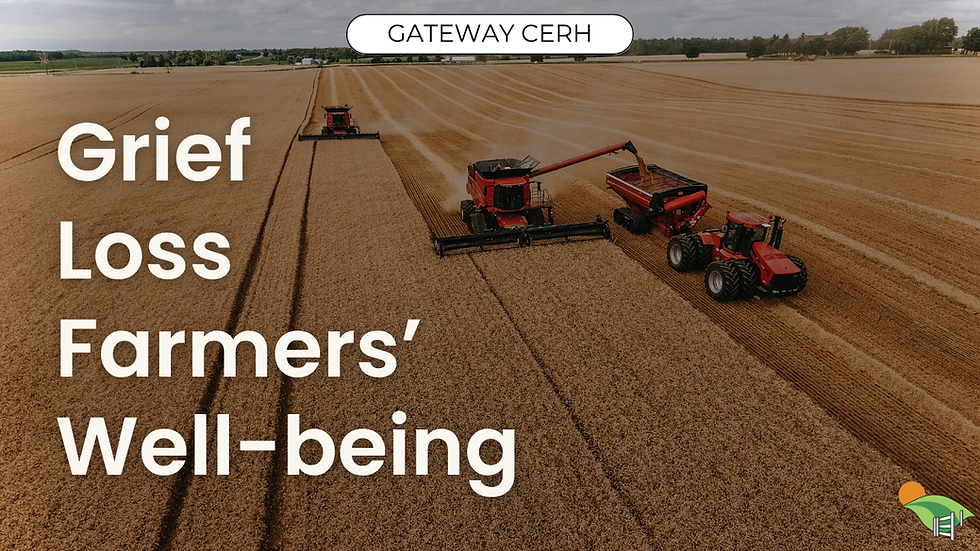
Canada is an agricultural powerhouse, generating over $149 billion of Canada’s gross domestic product. With over 189,874 farms covering 62.2 million acres, diverse climates and innovative research promote a range of crops from coast to coast through the Country. Despite these strengths, people in the agricultural industry are facing an increasing range of challenges. Economic uncertainty with close trade partners has disrupted close-knit supply chains, agricultural has an aging workforce and a labour shortage, and there are increasing land-use conflicts as prime agricultural land competes with demands for development. These stressors have an impact on farmers’ mental well-being.
In 2021, Dr. Andria Bitton-Jones, a Professor at the University of Guelph, found that 76% of Canadian producers were experiencing moderate to high stress. Prior research has found that stress, anxiety, and depression can be prevalent in the industry. Locating support for a farmer who is stressed is challenging. Rural areas lack many of the necessary primary care resources for mental health. Perception of stigma from peers and lack of accessibility of mental health services can further complicate the capacity of people within agricultural areas to seek care.
As an organization, Gateway Centre of Excellence in Rural Health (CERH) aims to promote the health and well-being of rural residents through research, education and communication. Understanding these complicated stressors and grief as it emerges is important to promote the well-being of rural communities.
Webinar - Grief We Carry and Roles We Inherit: Mental Wellness in Rural Families
On April 14, 2026, Gateway CERH hosted a webinar on “Grief We Carry and Roles We Inherit: Mental Wellness in Rural Families,” introducing complicated grief as it shows up in rural life, where loss often affects not only families but also farms, businesses, and community roles. It goes on to describe resources but also how solutions and supports can be built. This webinar featured Lauren Van Ewyk (National Farmer Mental Health Alliance), Diane Bergsma (Three Oaks Cabin), and Ben Tobias-Murray (Ontario Farmland Trust).
Complicated Grief & Resiliency
Lauren Van Ewyk is a co-founder of the National Farmer Mental Health Alliance, a registered social worker, and a PhD student at the University of Guelph. The National Farmer Mental Health Alliance is an organization that provides counselling to farmers and trains health care professionals on strategies better equipped to support farmers and their families.
Lauren introduced ideas of complicated grief and resiliency within farming. She describes how loss of land and identity can be carried forward within families, and what that means for mental well-being over time.
For instance, the capacity to be a farmer is intertwined with a person’s identity. Physical trauma that prevents a person from continuing to farm is stressful. As she discusses, “I had a cousin who was involved in a tractor accident and experienced a crush injury, and he said my thought wasn't like oh I'm in pain or oh I won't be able to walk again; my thought is how is this farm going to survive?”
Farmers face challenges unlike other professions; loss can look a lot different. Barn fires or machine accidents can result in devastating injury or death. A bad crop year or loss of livestock can result in financial hardship. Bankruptcy that prevents a person from passing on the family farm to the next generation can result in feelings of shame or guilt. The depopulation of rural areas resulting in the loss of a local grocery store, hardware store, or other nearby services.
Lauren is actively working towards building resilience within agriculture. She describes resiliency as the “capacity of individuals and systems to navigate adversity through flexibility, skill development, and adaptation to change while also recognizing hardship and fostering healing connection and growth.”
Read more about resiliency by Lauren Van Ewyk: Farmer Wellness: The Dark Side of Resilience
Supports for Farmers: The Three Oaks Cabin
Diane Bergsma, co-founder of the Three Oaks Respite Cabin, is a farmer whose son died by suicide. He was a farmer and a firefighter within his community. She discussed during the the webinar how this was a devasting loss for her family. In his memory, her family built the Three Oaks Respite Cabin for farmers and first responders to find a quiet place for recovery from stress.
The cabin opened in March 2024 and it provides accommodations but also ongoing supports and resources that people can take with them in their healing journey. It offers self-directed programming and counselling from people who are trained in providing support for others within agriculture. Any farmer or first responder is welcome to reach out to gain support.
Other resources to support farmers available:
Gateway CERH has a project to promote the well-being of farmers called Farmers' Safety & Well-Being. The S.H.E.D. Talks (Sustaining Healthy Farms through Empowerment and Dedication) project was developed by Gateway CERH as a way to provide farmers with a safe, welcoming space to share their experiences and discuss the realities of agricultural life. Events have been held in Stratford and Brussels.
Learn more about Gateway CERH’s Farmers’ Safety and Well-Being project here.
Succession Planning: Ontario Farmland Trust
Challenges to the agricultural labour force are happening at a time of transition. Farmers are older than the average Canadian. As people continue to age and retire, there will be a significant number of farms changing hands within the next few years. However, very few farmers have plans in place for what happens to the farmland for when they retire. In the 2021 Census of Agriculture, only 12% of farmers reported having a succession plan. The loss of identity as a “farmer” can be difficult as they are no longer able to continue farming.
Farming is often a generational experience. However, many farmers do not have a family member who wants to, or is capable of taking over the family farm. Pressures in the agricultural industry to convert land into industrial or housing uses can cause further community disruptions. Dr. Sara Epp, a University of Guelph professor, found that over the past 35 years, Ontario has lost 18% (2.8 million acres) of it’s farmland to non-agricultural uses.
Ben Tobias-Murray, Farmland Access and Agricultural Planning Coordinator at Ontario Farmland Trust (OFT), introduced the OFT to viewers. OFT is an organization with a mission to protect and preserve Ontario farmlands and associated agricultural, natural, and cultural landscapes of food production for the benefits of Ontarians today and future generations.
The OFT do their farmland protections through what is known as Farmland Easement Agreements. These are voluntary agreements on the land title which limits use of the property or parts of a property to farming and conservation. This ensures the land will be used for farmland for future generations.
The OFT can serve as a way of protecting farmland from external pressure but also serve as a bridge to new generations of farmers. They have a farmland access program which provides farming opportunities to new young and underrepresented farmers who otherwise wouldn't be able to access farmland.
Learn more about OFT, easements, and access to farmland programs here.
Webinar – Watch Now
A full recording of the webinar can be viewed online on the Gateway CERH YouTube Channel.
Gateway CERH has explored farmers well-being and resiliency in previous webinars:
Lecture # 20 | S.H.E.D. Talks
Lecture # 14 | Great Local Food
About Gateway Centre of Excellence in Rural Health
Founded in 2008 in the community of Seaforth, ON, Gateway CERH is a not-for-profit rural health research organization run by a community-based volunteer board of directors. Gateway CERH's main mission is to better the health and quality of life of rural residents through research, education and communication. Follow us on Instagram, Facebook, LinkedIn and YouTube.
A brief disclaimer: the views expressed in these lectures may not necessarily reflect Gateway CERH’s views or opinions, but we believe in providing a platform for a range of perspectives and thoughtful discussion.
Gateway CERH has a full library of lectures and information about the upcoming presentation that can be found on our website: Gateway CERH Virtual Lecture Series.
Or watch all past lectures online on YouTube: Gateway CERH YouTube.


Comments